



Ask anyone in tech where AI is headed, and you’ll get a confident answer in about four seconds. Predictions are free, and no one remembers the ones that miss. So we wanted something with more skin in it: not a forecast, but a bet, the kind that comes with a stake you put on the table and a tell that settles the score.
That framing matters more than usual right now. What the technology can do stopped being the interesting question. The models are capable, and the demos dazzle. The quieter question is the one that actually decides whether any of this pays off by year-end: what will people do with it? Will businesses build instead of buy? Will teams trust the tools already sitting in front of them? Will curiosity turn into commitment, or stall out at the demo?
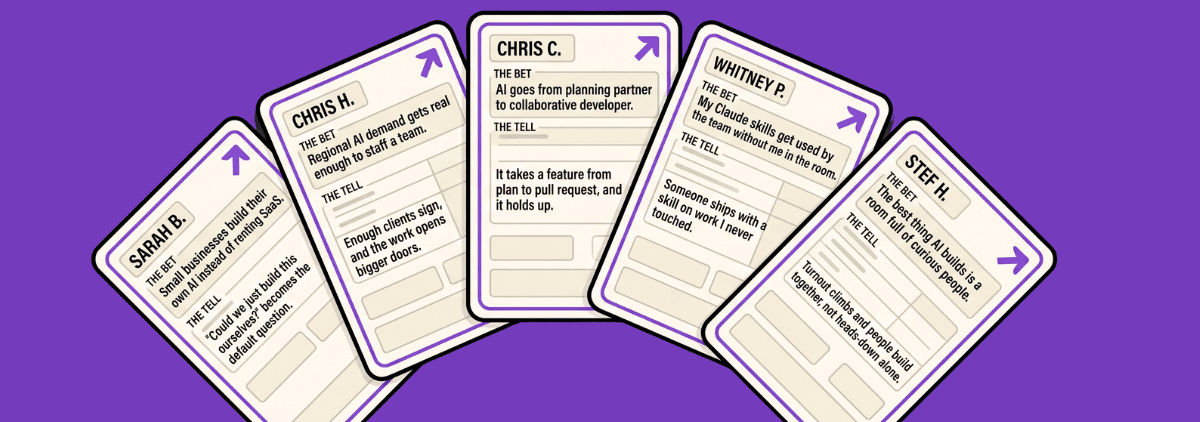
So we asked some of our team to skip the safe forecast and place a real bet on what shifts between now and December. Each person named a stake and a tell. Here’s where they put their chips, and exactly how they’ll know if they were right
Summary
Five bets land in very different places: small businesses building their own tools instead of stacking another subscription, regional AI curiosity hardening into contracts worth staffing a team around, and AI agents carrying a feature from plan to pull request. The sharpest tells are the ones that can break either way, like an internal tool that only works when the person who built it is in the room. And the most contrarian wager of the set has nothing to do with software at all.
Small Businesses Would Rather Build Than Rent
For a decade, the reflex answer to any business problem sounded the same: there’s an app for that. Sign up, pay the monthly fee, move on. Sarah Bhatia, Director of AI Product Innovation, thinks that reflex is finally cracking.
“By December, more small businesses will build their own AI solutions instead of signing up for yet another SaaS subscription,” Sarah says. “Monthly fee fatigue is real.”
Her point goes beyond budget lines. Owners look at their software stack and see a dozen underused tools that all bill monthly and never talk to each other. AI changes the math on the other side of that equation. When a founder can describe what they need in plain language and get a working tool back, “build it yourself” stops sounding like a six-figure engineering project and starts to sound like a Tuesday.
Sarah is backing that bet with her time, teaching MBA courses on AI in Business Innovation so the next wave of leaders sees building as a real option rather than a last resort. Her tell is refreshingly concrete. The signal she’s watching for is a question: “could we just build this ourselves?” If she hears it more often from students and the businesses she advises, she called it. Bonus points if SaaS churn ticks up while build-your-own adoption grows. If companies keep happily stacking subscriptions come December, she was wrong.
Curiosity Is Not a Business Line Yet
Interest in AI is everywhere. Actual demand, the kind that comes with a signed contract, shows up far less often. Our CIO, Chris Howard, is betting the two are about to meet.
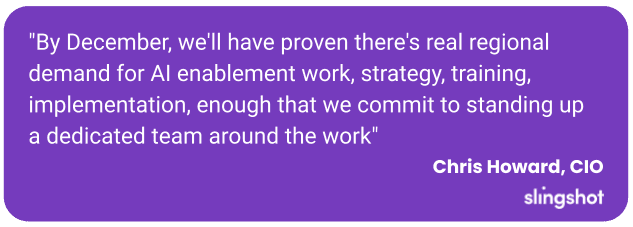
“By December, we’ll have proven there’s real regional demand for AI enablement work, strategy, training, implementation, enough that we commit to standing up a dedicated team around the work,” Chris says.
That bet lives right on the fault line every services business knows well. Interest is free. It shows up at every lunch and every conference. Demand is different, because it comes with a start date and a budget behind it. Chris is wagering that enough local companies move from “we should really look into this” to “let’s go,” and that the work pulls through into bigger consulting engagements.
His stake is the unglamorous groundwork that actually moves deals: refreshing the website, building new marketing material, and getting in front of local companies through outreach, lunches, coffee, and the occasional beer. He’s out starting conversations, not waiting for the phone to ring.
The tell cuts both ways with no wiggle room. He calls it if two things happen: Slingshot signs enough enablement clients to staff a dedicated team, and that work starts opening doors to other engagements. If the pipeline stays thin and companies keep waiting for someone else to go first, he was wrong. In a market this new, somebody has to move before the crowd does.
When AI Stops Advising and Starts Shipping
Most developers using AI today treat it like a sharp intern: great for research, planning, and breaking a big job into small ones, but you still write the real code yourself. Our Senior AI Developer, Chris Chandler, is betting that boundary moves this year.
“By December, I’ll be using AI agents as collaborative developers, not just planning partners,” Chris says.
He uses AI to analyze features, create user stories, and develop detailed plans that help him navigate a new architecture and contribute confidently to a large codebase. This is useful but just a step toward the ultimate goal.
The prize is trust. Chris is doing the quiet prep work that earns it: giving AI better context, setting clear boundaries, and building repeatable workflows so it can own larger chunks of the development cycle. He wants to hand off a feature and get back real work, not a mess to untangle.
His tell is the one every engineer respects. He will know the bet paid off when he trusts AI to carry a feature from plan to pull request, including creating the branch, writing the code, running the tests, and opening it for his review. If the output holds up to the project’s architecture and standards, he wins. If he still spends more time fixing its work than it would have taken to build the feature himself, he was wrong.
A Tool Nobody Opens Is Just a Clever Demo
Anyone can build something impressive. The real challenge is getting other people to use it on real work, without you there to run it. That is where most internal tools quietly die. Whitney Powell, Sales and Marketing Coordinator, is betting against that fate for the AI skills she built.
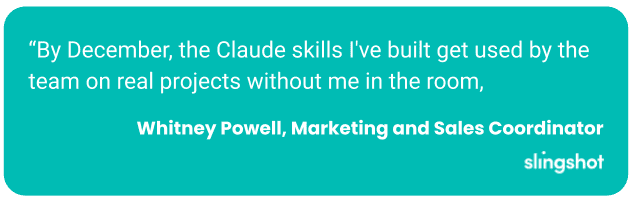
“By December, the Claude skills I’ve built get used by the team on real projects without me in the room,” Whitney says.
That is the whole adoption problem right there, and it trips up more teams than anyone expects. A skill that works flawlessly in a demo but never fires reliably for anyone else is not a system. It’s a party trick with a single operator. So Whitney shifts her energy from building to making things stick: fixing the loading so the skills fire every time, documenting them so nobody needs her to translate, and putting them in front of people during actual work instead of a staged walkthrough.
Her tell doubles as the sharpest self-assessment in the whole set. “If someone uses the brand voice or design skill on something I never touched and it comes out right, I was right,” she says. “If I’m still the only one opening them, I built a fancy solo toolkit and called it a system.” That line belongs on the wall of every team rolling out internal AI. The measure of a tool is not how good it is. It’s whether anyone else reaches for it.
The Most Valuable Thing AI Builds Might Be a Room Full of People
Every other bet here points at software. Our Product Lead, Stef Hogan, points the opposite direction, and she might be making the most interesting wager of the bunch.
“The most valuable thing I build through AI this year won’t be a feature or an agent system,” Stef says. “It’ll be a growing room full of curious people helping each other figure this out.”
The logic runs almost like a paradox, and that is what makes it land. “The more hours we spend staring at a screen doing cool AI things, the more we crave the opposite,” she says. As work becomes more automated and solitary, the valuable thing is showing up in person to discuss the hard parts. AI can generate answers but can’t replace the room where people share what works.
Stef backs that instinct with her calendar, pouring energy into her community vibe code nights, contributing to Slingshot’s AI Exchange, and helping plan Startup Week and HackKentucky. Her tell is turnout and behavior: attendance climbing, and people spending more time talking and building together than sitting heads down and silent. In an industry racing to automate every interaction, betting on gathering people in a room feels almost rebellious. It also feels right.
The Chips Are Down
Look across the table, and a single through-line emerges: everyone agrees AI is capable. The real questions are about what happens next: will businesses build instead of rent, will markets turn into paying clients, will developers trust AI to ship, and will tools get used? In a screens-dominated year, our greatest value may be each other.
That is the real frontier now, and it’s a human one. The technology already made its move. Between now and December, the tells will do the talking, and each of us will find out whether we placed a smart bet or just made a comfortable guess.
The models have already shown their hand. Before the year ends, the only question left is what you are willing to put on the table.
Inside a Two-Person AI Machine

Written by: Whitney Powell
Whitney earned her degree in Marketing and Management from the University of Kentucky and discovered her passion for marketing and events. Her go-getter attitude, willingness to learn, and problem-solving abilities elevate the Slingshot team. Known as a daredevil, Whitney loves trying new things and embracing challenges, whether traveling to new places or taking on new projects at work.

Expert: Chris Howard
Chris has been in the technology space for over 20 years, including being Slingshot’s CIO since 2017. He specializes in lean UX design, technology leadership, and new tech with a focus on AI. He’s currently involved in several AI-focused projects within Slingshot.

Expert: Sarah Bhatia
Sarah Bhatia brings people together. In her decade plus of product and product-adjacent experience, her focus has been on cross-functional collaboration, asking lots of questions, and getting big results. She excels at strategy development, and getting the right brains in the room to solve big problems. Sarah would describe herself as a daredevil, because she’s not afraid to ask all the questions, get smart answers, and take (calculated) risks.

Expert: Chris Chandler
Chris brings decades of software development experience, from DOS-era systems to cloud and AI. He’s led engineering teams in healthcare tech, modernized legacy systems, and helped organizations make smarter technical decisions without overcomplicating things. He also completed a postgraduate program in AI and machine learning. A self-described big kid, Chris still builds retro-style video games and tinkers with new tech just to see what it can do.

Expert: Stef Hogan
Stef Hogan has spent her career at the intersection of product, technology, and team operations. She’s led work across shopper experiences, authentication, and cloud migration, and became a go-to voice on AI enablement, helping teams turn emerging tech into things that actually work. She’s a fixture in Louisville’s AI and builder community, and outside of work you’ll find her coaching basketball, cheering for Michigan, or spoiling her dogs Woodson and Loki. A true big kid, Stef believes in curiosity, play, and the wonder that makes the world feel full of possibility.
Frequently Asked Questions
Subscription fatigue is a real budget pressure, and most owners can point to a stack of underused tools that never talk to each other. AI changes the cost side of that decision. When someone can describe what they need in plain language and get a working tool back, building stops looking like a six-figure engineering project and starts looking like a reasonable afternoon.
Not yet, but the boundary is moving. Most developers still use AI for research, planning, and breaking large jobs into smaller ones while writing the real code themselves. The next step is trusting an agent to take a feature from plan to pull request, including the branch, the code, and the tests, with the developer reviewing rather than rebuilding. That trust gets earned through better context, clear boundaries, and repeatable workflows.
Reliability, documentation, and exposure during real work. A tool that only performs in a demo, or only when its creator is in the room, is a party trick rather than a system. The honest measure of adoption is whether someone else reaches for it on a project you never touched and gets a result that holds up.
Interest and demand are different things. Interest shows up at every lunch and conference and costs nothing. Demand comes with a start date and a budget behind it. The signal worth watching is whether companies move from wanting to look into AI to signing contracts for strategy, training, and implementation, and whether that work opens doors to larger engagements.
The room. AI can generate answers, but it cannot recreate the value of people gathering to talk through the hard parts, share what actually worked, and learn from each other's failures. The more hours teams spend heads down with AI tools, the more they tend to want the opposite, which makes community and in-person collaboration more valuable rather than less.