




Most AI conversations start with the same question: what can we hand off? It’s a fair question; it’s also the easy one.
The harder question, and the one that actually shapes how a company works, is the opposite. What won’t you hand off? Where does the automation stop, on purpose, because a person needs to be standing there?
Among people who use these tools every day, the answer is fast and surprisingly consistent. Nobody argues the technology isn’t good enough. The hesitation runs the other direction: it’s good enough to get you most of the way there, which is exactly why you want to be the one who finishes.
That distinction turns out to be the whole ballgame.
Summary
The boundary that matters isn’t a list of banned tools, it’s a single question: can this be undone? Sort every workflow by that answer and the roadmap mostly builds itself, with reversible work running at full speed and permanent actions holding for a person who understands what they’re approving. Two three-second tests do most of the sorting, and the teams getting the most out of AI turn out to be the ones who know exactly where to stop.
The 10-yard line rule
The cleanest frame on it runs like a football metaphor.
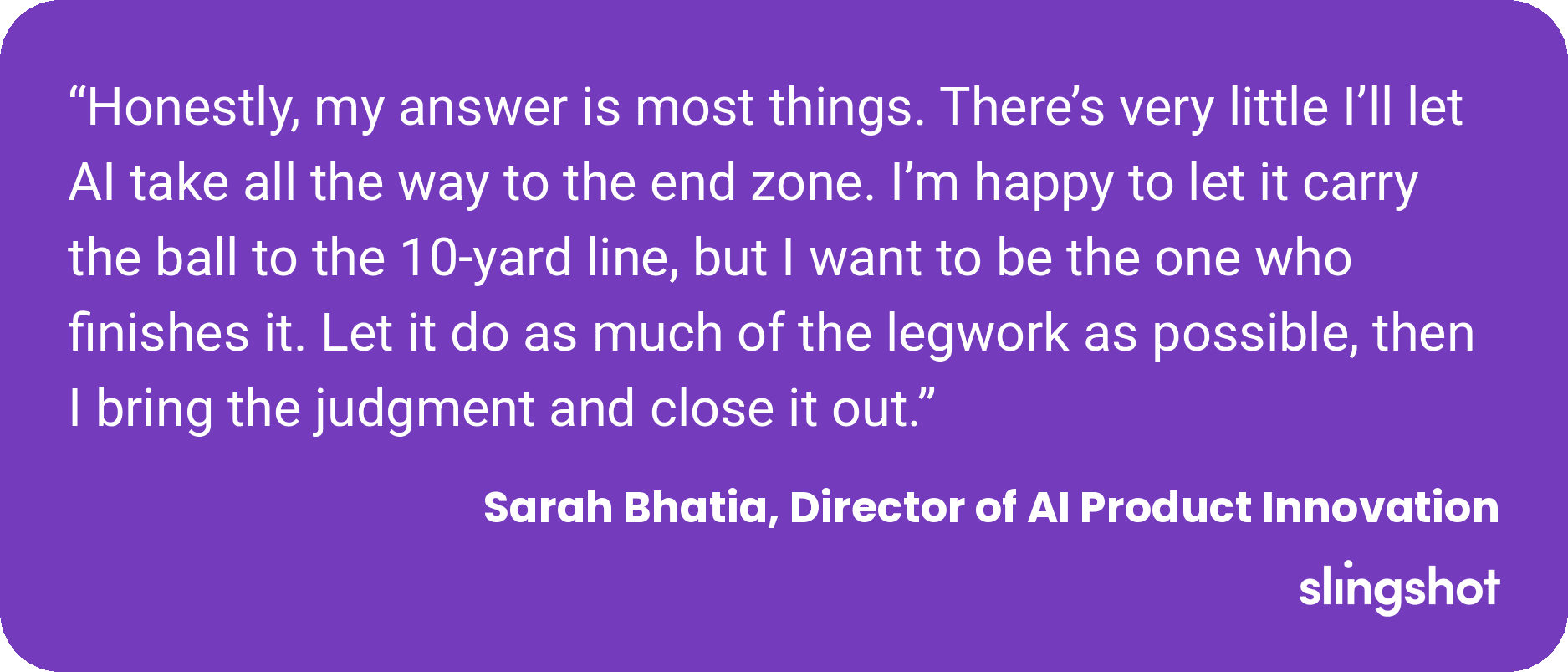
“Honestly, my answer is most things,” said Sarah Bhatia, Director of AI Product Innovation. “There’s very little I’ll let AI take all the way to the end zone. I’m happy to let it carry the ball to the 10-yard line, but I want to be the one who finishes it. Let it do as much of the legwork as possible, then I bring the judgment and close it out.”
Read that again, because it isn’t a limitation; it’s an operating model. Sarah isn’t using less AI than someone who automates end to end. She’s probably using more of it, because she’s comfortable letting it run hard across the first 90 yards. Research, synthesis, first drafts, options, formatting, the grunt work nobody misses: all of it goes to the machine.
What she holds back is the very beginning and the last stretch, where the work stops being production and starts being judgment. That’s where context lives: the client relationship nobody wrote down, the political landmine in paragraph three, or the reason this quarter is different from the last.
For leaders mapping out an AI strategy, that framing is more useful than a list of approved tools. You’re not deciding whether to adopt AI; you’re deciding where your 10-yard line sits for every workflow you own.
The line sits right before the decision
The same boundary shows up from a different direction, as a rule that’s easy to hand to a whole team.
Stef Hogan, Product Lead at Slingshot, said: “I’d automate everything up until the point of an actual decision that matters. The research, the gathering of data points, the surfacing of it; all of that. But not the decision itself. Just because the models are incredible doesn’t mean they have all the context to make the best call.”
Notice what she’s not saying: not that the models are unreliable, or that the output is bad. She’s saying the model is working with a partial picture, and decisions get made on the full one.
Her example is deliberately small, which is what makes it land. “I’ll use AI to build my grocery list from the meals I want to make and photos of my cabinets. But I won’t let it place the order without me looking through it, approving it, understanding it. That’s not a huge decision, but it involves money, so it requires oversight,” said Stef.
A grocery order is about as low-stakes as a decision gets. If that one earns a human check, the ones with vendors, contracts, and headcount attached certainly do.
There’s a quiet second idea in there too: approving it, but also understanding it. Those aren’t the same thing. A rubber-stamp approval is automation with extra steps and a human name attached for cover. The oversight only counts when the person reviewing actually knows what they’re looking at.
Anything with your name on it
The fastest agreement of all lands on communication. Nobody wants AI talking to people on their behalf without a checkpoint.
“I’d never let it automate anything to do with contacting people in my life or my work contacts. Everything I say and do gets approved by myself first,” said Whitney Powell, Marketing Manager.
The same boundary holds in system terms. Rachel Foster, Principal Product Designer, said: “A free-for-all write-and-send on messages and email, with no human-review stopgap? No. There has to be a checkpoint.”
This one deserves more attention than it usually gets, because it’s the automation companies are rushing toward hardest right now. Auto-drafted follow-ups. Auto-sent sequences. Agents that reply to inbound on their own.
The appeal is obvious, but so is the exposure. Every outbound message carries your name, your company’s name, and an implied promise that a person meant it. When an automated message arrives wrong, the recipient doesn’t file a bug report. They form an opinion about you, and they keep it.
Here’s the part that’s easy to miss: a review step costs almost nothing. Reading a drafted email takes seconds, while writing one takes minutes. You keep roughly all the speed and cut nearly all the risk.
That’s an unusually good trade, and teams skip it anyway because ‘approve each message’ feels like one step backward from full autonomy. It isn’t. It’s what makes full-speed drafting safe to use.
If you can’t undo it, don’t automate it
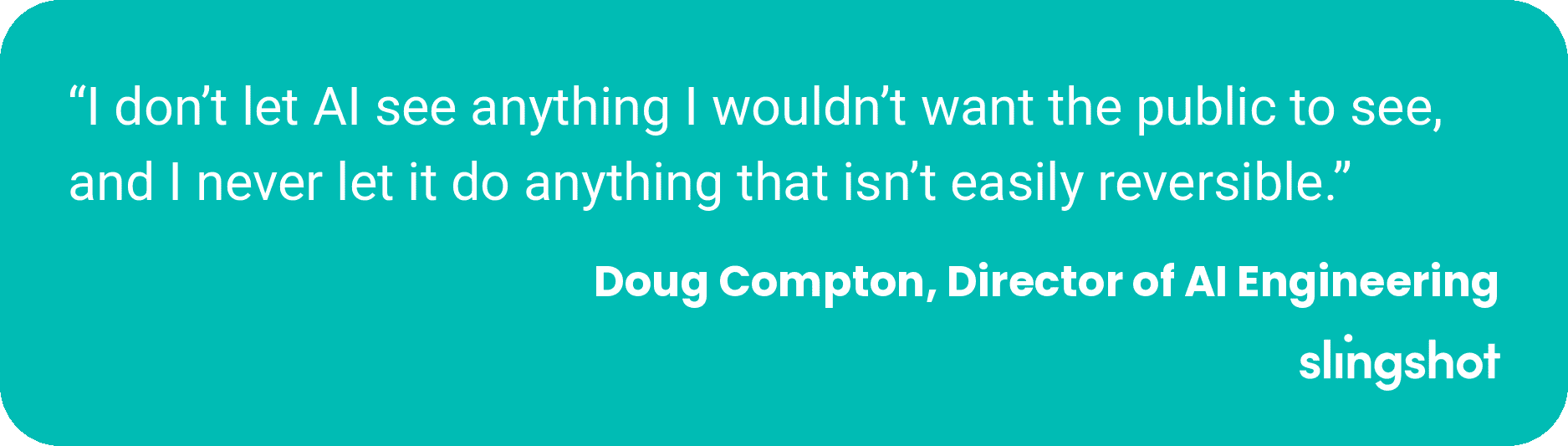
One version of this belongs on a wall: “I don’t let AI see anything I wouldn’t want the public to see, and I never let it do anything that isn’t easily reversible,” said Doug Compton, Director of AI Engineering.
Two tests, both answerable in about three seconds, and together they cover most of what goes wrong with AI in a business.
The first is an exposure test. Assume anything you feed a tool could surface somewhere you didn’t plan on. If that thought makes you wince, the data doesn’t go in. That single question resolves most ‘is this okay to paste’ debates faster than a policy document does.
The second is the reversibility test, and it’s the sharper of the two. Ask whether a mistake costs you five minutes or five weeks. A bad draft is reversible, and a misfiled document is reversible. But a sent email, wire transfer, deleted production record, or a public post isn’t.
Sort your workflows by that line, and your automation roadmap mostly builds itself. Everything reversible moves fast. Everything permanent gets a person. You don’t need a committee to apply it, which is exactly why it works at scale.
It also explains why money is the category nobody hesitates on. Rachel’s hard line is automation inside financial accounts, and Stef’s is a grocery order she won’t let go through unreviewed. Those sit miles apart in stakes and land in the same place, because money moves in one direction and doesn’t come back.
Understanding sets your speed limit
Rachel makes one more point that reframes the whole topic, and it’s the one worth sitting with: “Out in the wild, people seem willing to automate practically everything in their lives without any oversight. If you graphed it, I think you’d see a strong correlation between how much someone understands concerning the tech and how much they’re actually willing to automate day to day,” she said.
That’s backward from the usual assumption. We tend to picture the AI-savvy person automating everything and the skeptic holding back. In practice, it runs the other way. The people who understand how these systems fail are the most deliberate about where they let them run unattended. The people automating hardest are often the ones who’ve never seen a model confidently invent something.
Stef watched that gap up close and found a genuinely good use for AI on the other side.
“My grandpa has been scammed twice through email, clicking a link to buy a big TV for a dollar. So I showed him how to screenshot it and send it to AI to ask whether it’s a scam before he clicks. It’s been a real gamechanger,” said Stef.
Look at what that actually is: AI as the advisor, not the actor. It reads, assesses, and explains. Her grandfather still makes the call. He’s safer than he was, and he hasn’t handed over his inbox or his credit card to do it.
That’s the same 10-yard line, just drawn around someone who’d never use that phrase.
The pattern underneath
Put it together, and nobody on our team is anti-automation. They’re anti-abdication, which is a different thing entirely.
Every boundary here lands in the same place: let AI do the legwork, the research, the drafting, the surfacing, the first 90 yards. Keep the human on the decision, the send button, the irreversible action, and anything carrying your name. Automate right up to the edge of consequence, then stop and look.
The teams getting the most out of AI aren’t the ones who handed over the most. They’re the ones who knew exactly where to stop.
Because the question was never how much you can automate. It’s how much you’re willing to be responsible for after you do.
What Doesn't Change Here

Written by: Savannah Cherry
Savannah leads marketing and new business at Slingshot. She writes, posts, and creates all things Slingshot, and helps companies navigate working with a tech partner for the first time. While she isn’t developing software, her CIS minor and a tendency to tinker with AI tools to streamline her own work keep her up to speed on the team’s work. She co-organizes and hosts the Louisville AI Exchange, and she can’t rest until all her work is done.

Expert: Whitney Powell
Whitney earned her degree in Marketing and Management from the University of Kentucky and discovered her passion for marketing and events. Her go-getter attitude, willingness to learn, and problem-solving abilities elevate the Slingshot team. Known as a daredevil, Whitney loves trying new things and embracing challenges, whether traveling to new places or taking on new projects at work.

Expert: Sarah Bhatia
Sarah Bhatia brings people together. In her decade plus of product and product-adjacent experience, her focus has been on cross-functional collaboration, asking lots of questions, and getting big results. She excels at strategy development, and getting the right brains in the room to solve big problems. Sarah would describe herself as a daredevil, because she’s not afraid to ask “dumb“ questions, get smart answers, and take (calculated) risks.

Expert: Doug Compton
Born and raised in Louisville, Doug’s interest in technology started at 11 when he began writing computer games. What began as a hobby turned into his career. With broad interests that range anywhere from snorkeling, science, WWII history and real estate, Doug uses his “down time“ to create new technologies for mobile and web applications.

Edited by: Rachel Foster
As UX Lead, Rachel helps guide the design team through strategy, interviews, creation, and testing. Designing software and apps to be both intuitive & beautifully impactful plays into Rachel’s strong desire to connect others. Relying on her Fine Arts background & honed intuition, she gets sudden flashes of ideas and follows them wherever they lead.

Expert: Stef Hogan
Stef Hogan is a product and engineering leader at Slingshot, focusing on product, technology, and AI. Previously, she was the Director of Engineering and Product Operations at a payments company, leading initiatives on shopper experiences, authentication, and cloud migration. She is recognized for her expertise in AI enablement and is active in Louisville’s AI and builder community, fostering experimentation with emerging technologies.
Frequently Asked Questions
Do not automate decisions that carry real consequences, actions you cannot easily reverse, messages sent under your name, access to financial accounts, or anything involving data you would not want made public. AI handles the work leading up to those points well. The final step belongs to a person who understands what they are approving.
Automation should stop right before the decision. Research, data gathering, synthesis, first drafts, and formatting all run safely on AI. The moment a workflow produces a choice that commits money, people, or reputation, a human takes over. That boundary keeps most of the speed while removing most of the risk.
No. AI should draft outbound messages, but a person should approve every send. Every message carries your name and an implied promise that a human meant it, and a wrong one cannot be recalled. Reading a drafted email takes seconds while writing one takes minutes, so the review step costs almost no speed.
Apply two tests. The exposure test: would you be comfortable if this data surfaced publicly? If not, it does not go into the tool. The reversibility test: does a mistake cost five minutes or five weeks? Reversible work can run automatically. Permanent actions such as sent emails, wire transfers, deleted records, and public posts need a person.
Because they have seen how these systems fail. People who understand model behavior know that confident output is not the same as correct output, so they are deliberate about where AI runs unattended. The heaviest unsupervised automation usually comes from people who have never watched a model invent something convincing.