



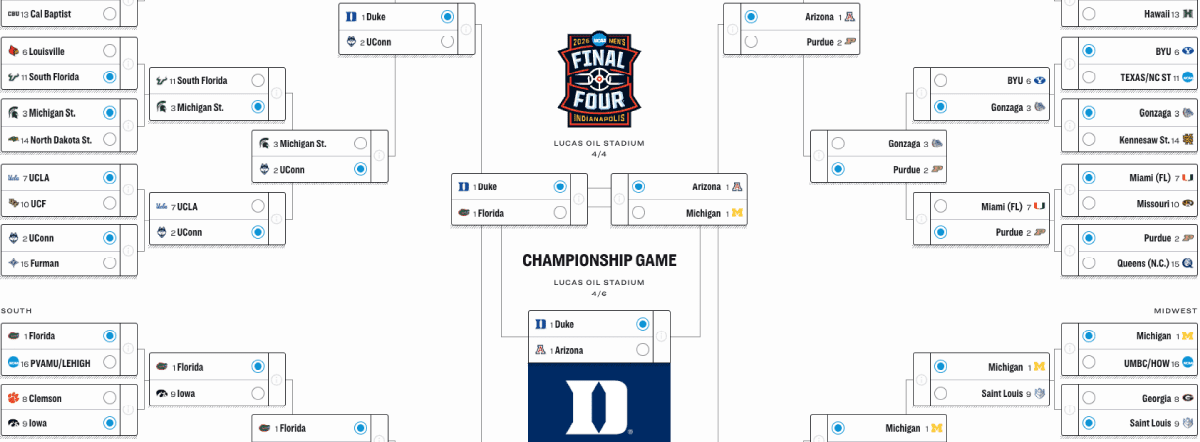
Every year, Slingshot runs an internal NCAA bracket challenge. And every year, it gets competitive. Last year, a few team members decided to let AI do the heavy lifting on their picks. As you can imagine, it went horribly.
But we’re not the kind of team that walks away from a bad experiment. We’re the kind that figures out what went wrong and tries again with twice the spreadsheets.
This year, we wanted to do it right. Not just “ask AI to fill out a bracket” right, but actually build a research-backed process and see what happens when you give AI good inputs instead of lazy ones. The difference between a bad AI output and a useful one is almost never the AI. It’s the preparation behind it.
So we started from scratch. Fair warning, though: there’s never been a perfect bracket for a reason. AI or not, March has a way of humbling everyone.
Start With the Research, Not the Prompt
The first temptation with any AI task is to skip straight to the prompt. We resisted that. Before writing a single instruction, we asked a more basic question: what does actual research say about accurate bracket prediction?
Turns out there’s a real answer. Start by picking your Final Four before touching the early rounds. Lean on efficiency metrics, not win-loss records. Prioritize defensive efficiency in March specifically. And pick strategic upsets at the 12-over-5 and 11-over-6 lines rather than going chaos mode throughout.
That research shaped everything that came after. The AI’s job was to apply a methodology, not invent one.
Then Came the Data Hunt
Good inputs make good outputs. We pulled together KenPom efficiency ratings for all 365 teams, T-Rank team charts including BARTHAG (probably the single most predictive number in the bracket), NCAA official free throw percentages, a full coaches table with career tournament history, and a first-round injury report covering every significant availability question heading into the tournament.
Finding all of it took some effort: Some sources blocked scraping, the coaches table had to be manually recreated, and free-throw data was in multiple places. Small friction points, but a good reminder that data gathering is real work even when AI is helping you think through it.
Building the Prompt
The prompt itself walked Claude through a six-step methodology: identify the Final Four first, work backward through the bracket, apply an injury filter, use coaching experience as a tiebreaker for close matchups, and check free-throw percentages for projected tight games. Every pick had to cite at least one specific stat. No hedging, just picks.
The injury report ended up driving some of the most interesting calls, including a couple that were genuinely painful to see.
A Note on Home Team Loyalty
We’re based in Louisville. Two teams in this bracket hit close to home, and the data was not kind to either.
Louisville drew South Florida in the first round. With Mikel Brown, a projected lottery pick averaging 18.2 points per game, sidelined since late February, the Cardinals’ offensive ceiling dropped significantly. South Florida’s BARTHAG of .8189 was legitimate enough to capitalize. The pick: South Florida. We did not enjoy that.
Kentucky drew Santa Clara. Jayden Quaintance, their best interior presence, was doubtful after ACL surgery. Without him, Santa Clara’s BARTHAG of .8929 actually exceeded Kentucky’s .8821. The pick: Santa Clara. Also not fun.
This is the part nobody likes to talk about in data-driven analysis: sometimes the numbers run counter to your team, and the whole point is to listen anyway. The process works on your favorites, too. Ruthlessly.
The Rest of the Upset Picks
VCU over North Carolina was the highest-confidence call in the field, driven entirely by Caleb Wilson’s season-ending injury. He had been averaging 19.8 points and 9.4 rebounds. Without him, UNC’s offensive profile dropped right into VCU’s defensive wheelhouse.
High Point over Wisconsin hinged on Nolan Winter’s ankle injury. Winter was Wisconsin’s best interior defender, and High Point had the 23rd-best offensive rebounding rate in the country. That matchup wrote itself.
What the Bracket Said
The Final Four: Duke, Florida, Arizona, Iowa State. All one-seeds. The championship came down to Duke over Arizona, 78-71.
What We Actually Learned
The AI didn’t “do the bracket.” It applied a framework we built based on the data we gathered, using a methodology we researched first. The output was only as good as all three of those things.
Whether Duke actually cuts down the nets in April is a completely different question. That’s the magic of March: anything can happen, and it usually does.
And honestly? There’s a solid chance a die-hard basketball fan with good instincts still beats this bracket. The data gives you an edge, but it doesn’t watch film, feel momentum, or know which team showed up flat after a long bus ride. Some things are still human.
In the meantime, Go Cards. Go Cats. The data just didn’t agree with us this year.
Want More Fun Content?

Written by: Savannah Cherry
Savannah is our one-woman marketing department. She posts, writes, and creates all things Slingshot. While she may not be making software for you, she does have a minor in Computer Information Systems. We’d call her the opposite of a procrastinator: she can’t rest until all her work is done. She loves playing her switch and meal-prepping.
