




Pull up a job description your company last used to hire a developer or a designer. Read it carefully. Now ask yourself: Does it mention AI anywhere? If you wrote it over two years ago, it probably doesn’t.
Most job descriptions haven’t kept pace with how much these roles have actually changed. The skills that made a strong hire two or three years ago are not the same ones that make a strong hire today. And the gap isn’t just about adding AI to a bullet point list. It runs deeper than that.
Summary
The skills that define a strong hire today look nothing like they did three years ago, and outdated job descriptions are quietly filtering out the wrong candidates. Both developer and designer roles have shifted from execution to orchestration, making judgment, foundational knowledge, and AI fluency the new baseline expectations. The leaders who update their hiring criteria now, and their interview process to match, will build teams that can actually direct AI rather than be directed by it.
The First Sign Something Is Off
Looking back at Slingshot’s own job postings from several years back, there’s one obvious flaw for today’s market: neither mentions AI. That sounds simple. But the absence goes deeper than a missing keyword.
“The obvious thing that’s missing is that the old descriptions don’t mention AI,” said Nathan Thomas, Senior Developer at Slingshot. “But it also focuses a lot more on writing code as opposed to managing code.”
The old developer description is thick with execution specifics: write clean code, build APIs, and deliver across the Microsoft Stack. The past designer description is similarly hands-on: building vast Figma files, iterating on wireframes, and translating designs into dev specs. Both describe what someone will produce; neither describes what kind of thinker you need.
CIO of Slingshot Chris Howard noticed another tell: “We’ve changed the title from Senior .NET Developer to just Senior Developer,” he said. “The specific tech references matter less now. What you want is someone who can move with the landscape, because the tools that win out are going to be the ones that work best alongside AI.”
One title change. One quiet signal that locking a hire to a single stack is no longer a safe bet.
The Work Has Changed. The Job Description Probably Hasn’t.
Developers now spend less time writing code and more time managing, reviewing, and directing AI-generated output.
“A lot of people don’t write code anymore; they manage it,” Nathan said. “The skill is being able to read code, understand it, and make sure it’s valid.”
Slingshot has already changed its interview process in response. Where candidates used to be handed a blank slate and asked to write code, the new approach presents existing code and asks them to analyze it.
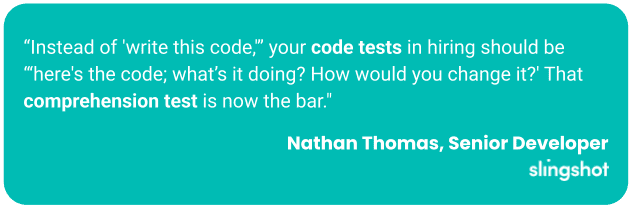
“Instead of ‘write this code,’ it’s ‘here’s the code; what’s it doing? How would you change it?'” Nathan explained. “That comprehension test is now the bar.”
The shift in design is just as sharp. Rachel Foster, Principal Product Designer at Slingshot, described the ‘old way’ as weeks of manual wireframing, expansive Figma files, and walking through every edge case by hand. That process now looks unrecognizable.
“AI handles the wireframing, the iterations, and plugs directly into Figma to pull in assets and components,” Rachel said. “We’re compressing many, many weeks of work and can now iterate very quickly.”
And the detail that would have genuinely shocked any designer just a few years ago: “Designers are now working directly in code,” Rachel said. “I never would have guessed that.”
Both roles have moved from execution to orchestration. A job description that only describes the former is hiring for a world that no longer exists.
Two Types of People. Only One Thrives With AI.
Nathan described a split that has always existed in development, but now carries far heavier consequences.
“There are two kinds of developers. The ones who take input and produce output: ‘give me a ticket, I’ll write the code, and I don’t need to understand the bigger picture.’ And then the ones who want to know why.”
Before, both types could succeed. A disciplined ticket-executor had a real place on the team. Today, AI handles the execution layer. What it can’t do is show up with judgment, context, or accountability; that part still belongs to the human.
Chris applied the same lens to design: “You’re now ‘bossing’ around the AI tool. You don’t want the AI tool bossing you around. You still need to be the expert who’s using it.”
Rachel saw the split showing up directly in portfolios. “If someone’s relying entirely on baked-in UI platforms like Lovable or Bolt to do all their design work, that’s a red flag. They’ve never had to guide it or push it; they can’t just use what it gives them.”
The people who thrive are the ones who walk in with enough expertise to know when the output is wrong, where it falls short, why it’s wrong, and how to fix it. That’s not a skill AI can replicate. It’s the whole reason you’re still hiring a human.
Foundational Knowledge Has Never Been More Valuable
Here is the uncomfortable irony: the skills AI makes easiest to skip are exactly the ones you need most to use AI well.
Nathan raised this concern: Architecture knowledge comes from hard-won experience, and AI is starting to bypass the path that builds it.
“I’ve never met anybody who learned architecture without going through at least one ‘trial by fire,’” he said. “Some of that fire is now gone because AI is doing it.”
The stakes: “AI can create things, but it may not know the best method; only a method. Expertise is crucial for effectively directing AI, distinguishing smart coders from those who aren’t.”
Rachel raised the same concern on the design side. “There may be generations that don’t actually know how to design. If you don’t know design essentials or are unable to execute design thinking, everything will end up looking the same. You simply can’t get to advanced solutions.”
Foundational expertise is no less valuable now; it’s more valuable, precisely because it’s harder to develop and easier to skip.
Taste, Judgment, and Curiosity Are Now Job Requirements
For both roles, the skills that now sit atop technical ability look less like certifications and more like human qualities.
For designers, Rachel put it plainly: taste. “I’m less concerned about what tools they’re using. I want to see their preferences and thinking. Can they curate well? Can they pull in inspiration that actually makes sense? Can they accelerate with AI while still driving the output? Good taste is crucial in today’s saturated markets. “
!["I want to see [designer’s] preferences and thinking. Can they curate well? Can they pull in inspiration that actually makes sense? Can they accelerate with AI while still driving the output? Good taste is crucial in today’s saturated markets."](https://b2168432.smushcdn.com/2168432/wp-content/uploads/2026/04/2-Job-Descriptions-That-Prove-AI-Has-Changed-Who-You-Should-Be-Hiring-1.png?lossy=2&strip=1&webp=1)
AI-generated design is starting to look homogenous, the same way AI writing does. A designer without taste cannot see past the first output. One with it can push toward something distinctive.
For developers, Nathan pointed to communication and business-level thinking. “The process of writing code is no longer the bottleneck. Developers have to move up a level: understand the product, have real conversations with the business, and shape what gets built.”
Chris saw both trends pointing to the same place. “Everybody has to have more of a manager or leader mindset. You’re overseeing what AI is doing, directing it, and doing it less yourself.”
What CEOs Can Do When They’re Not the Technical Expert
Most CEOs aren’t developers or designers. That doesn’t disqualify you from making a smart hire, but it does mean the old ways of evaluating candidates are even less reliable than they used to be. Strong-looking output is easy to produce with AI; depth is harder to fake, but also harder to spot if you don’t know what to look for.
Chris’s advice is to lean on the same tools your candidates are using. When evaluating a design portfolio, you don’t have to trust your gut alone. “If you don’t have that design background yourself, feed their work into Claude, describe what you’re looking for, and ask it to critique the work. See whether it matches what the candidate is claiming.”
It’s a low-lift move that gives non-technical leaders a more grounded lens than surface impressions alone can provide.
Beyond the portfolio review, Chris pointed to one signal that cuts across both roles and every hiring decision in this moment: “What really separates the people who are going to excel in this new market are the ones who’re studying at night, experimenting, and staying hungry. Not necessarily every day, but consistently.”
That curiosity, the kind that doesn’t clock out, is something you can hear in a conversation. It shows up in how someone talks about the tools they’re using, what they’ve tried recently, and what they’re watching closely. You don’t need a technical background to recognize it.
The Job Description Is the Starting Line
Every theme points to the same shift: both roles have moved from execution to orchestration, and the people who thrive are those who show up with judgment, foundational knowledge, and the curiosity to keep learning. AI handles the output. The human still has to own the direction.
The job descriptions that will attract those people don’t lead with a technology stack or a list of deliverables. They signal what kind of thinker you’re actually looking for. That means leading with AI fluency as a baseline expectation, not a bonus. It means valuing adaptability as much as specific tool knowledge. And it means asking whether a candidate can evaluate the work, not just produce it.
Our two old job descriptions proved that point simply by existing. The question now is whether you’re still making the same mistake.
Now Vet Your Consultant Too

Written by: Savannah Cherry
Savannah is our one-woman marketing department. She posts, writes, and creates all things Slingshot. While she may not be making software for you, she does have a minor in Computer Information Systems. We’d call her the opposite of a procrastinator: she can’t rest until all her work is done. She loves playing her switch and meal-prepping.

Expert: Chris Howard
Chris has been in the technology space for over 20 years, including being Slingshot’s CIO since 2017. He specializes in lean UX design, technology leadership, and new tech with a focus on AI. He’s currently involved in several AI-focused projects within Slingshot.

Edited by: Rachel Foster
As UX Lead, Rachel helps guide the design team through strategy, interviews, creation, and testing. Designing software and apps to be both intuitive & beautifully impactful plays into Rachel’s strong desire to connect others. Relying on her Fine Arts background & honed intuition, she gets sudden flashes of ideas and follows them wherever they lead.

Expert: Nathan Thomas
Understanding what people are trying to say, versus what they are actually saying, is one of Nathan’s great strengths. He uses this superpower coupled with technology to create solutions to problems. With a Computer Engineering degree from the University of Louisville and over a decade of software development experience, he brings both the technical depth and the people-reading instincts that great development requires. When the day is over, he goes home to enjoy a few of his favorite things: tv, bourbon, and petting dogs. Preferably all at the same time.
Frequently Asked Questions
Both roles have shifted from execution to orchestration. Developers now spend more time reviewing and directing AI-generated code than writing it from scratch. Designers are iterating through AI tools and working directly in code. The skills that matter most today are judgment, foundational knowledge, and the ability to evaluate output, not just produce it.
Modern descriptions should lead with AI fluency as a baseline expectation, not a bonus line item. They should emphasize adaptability over stack-specific experience, and signal that the role requires someone who can read, evaluate, and direct code, not just write it.
Watch for candidates who rely entirely on AI platforms without being able to critique or improve the output. For designers, heavy dependence on tools like Lovable or Bolt without evidence of independent design thinking is a concern. For developers, an inability to read and analyze existing code, rather than just generate new code, is a significant gap.
AI can produce output quickly, but it only knows a method, not necessarily the best one. Without foundational expertise, a developer or designer cannot catch architectural mistakes, poor decisions, or outputs that technically work but create long-term problems. That judgment only comes from experience AI cannot shortcut.
Use the same tools your candidates are using. Feed a designer's portfolio into an AI tool, describe what you're looking for, and ask it to critique the work against the candidate's claims. Beyond that, listen for curiosity: the people who thrive in this market are the ones actively experimenting and staying current, and that shows up in conversation.
