




If it feels like the ground beneath software developers is shifting, that’s because it is. The rise of AI agents, automation, and new architectural demands is redefining what it means to build software.
Developers aren’t just writing code anymore; they’re shaping systems, guiding intelligent collaborators, and driving strategic decisions that influence how products are built and scaled.
So what does this mean for the future of development? Let’s unpack how the role is evolving, and what business leaders need to understand as they rethink how to structure and support modern development teams.
Summary
From Coders to Conductors: Developers Are Becoming Orchestrators
The days of hard-coding every feature are fading fast. AI-assisted development is fundamentally changing how developers spend their time. Today’s engineers spend less time typing lines of code and more time orchestrating workflows, validating AI-generated output, and making judgment calls that affect the overall architecture.
“I write very little code by hand these days,” said Steve Anderson, Principal Developer and AWS Architect.
Slingshot’s Principal AI Developer Doug Compton put it this way: “There’s definitely hands-on keyboards. It’s just that the hands aren’t doing coding. It’s more talking to your AI.”
This shift also brings a different kind of multitasking. Doug noted, “You’re going to be jumping from AI to AI to keep them busy, and you’ll be multitasking more.”
This evolution repositions the developer as a systems-level thinker; someone who can balance context, architecture, and tooling to direct a network of intelligent contributors.
Multitasking and Prompting: The New Core Skills
Technical excellence is no longer just about writing efficient code; it’s also about communicating effectively with AI. Prompting has emerged as a core competency.
“Context, context, context. If you don’t give AI enough, it’ll hallucinate. Too much, and it gets confused,” Doug explained.
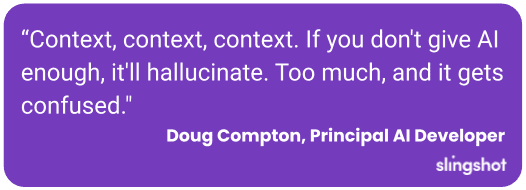
Strategic prompting requires developers to maintain a constant dialogue with machines, providing the proper context at the right time. That complexity introduces additional cognitive load demands, especially as developers toggle between multiple agents and tasks.
Steve shared a hard-won insight: “I can’t load more than two or three agents at once. I end up bouncing between windows and accomplishing nothing,” said Steve. “After that, it becomes negative returns. Not just diminishing, negative.”
The implication is clear: developers who succeed in this new era will be the ones who can manage attention, filter signal from noise, and maintain high-context awareness across distributed systems and teams.
Accountability Still Lives With the Human Developer
Despite the growing presence of AI in the development process, responsibility still lies with the human developer. Code quality, testing, and security remain mission-critical and are becoming more nuanced as systems grow more complex.
“Security goes beyond the code. It’s about architecture, access levels, and configurations,” said Andrew Meyer, Principal Senior Developer.
As development workflows incorporate more AI agents, the threat landscape is expanding. New technologies introduce vulnerabilities that didn’t exist before. Doug added, “AI opens up new realms of security issues. Prompt injection didn’t exist three years ago.”
As AI accelerates velocity, it also broadens the attack surface. Developers need to rethink their security posture not just at the code level, but across the full stack of tools, integrations, and data access points.
Architecture and Strategy Take Center Stage
As AI agents become extensions of the dev team, architecture becomes the new focal point. Developers are no longer just solving individual problems; they’re designing systems that must remain secure, adaptable, and context-aware, even when parts of those systems are unpredictable.
“You can’t treat the LLM as part of your normal API. It’s an untrusted external party,” said Steve. “You don’t take output from that and run it through without doing sanity checks on it, just like you wouldn’t take a form submitted by a user and send it straight into your database without validation.”
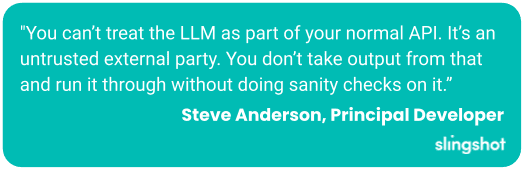
The issue isn’t intent; it’s trust. Even without malicious intent, LLMs are unpredictable and should be treated as any other unverified input. Reliable systems require validation and clear architectural boundaries.
Doug underscored the importance of architectural rigor: “The AI has amnesia. It doesn’t know anything unless you give it context.”
Clear documentation, modular design, and strict validation protocols are no longer best practices; they’re non-negotiable in AI-integrated environments.
AI Makes Testing and Tooling More Accessible
AI isn’t just writing code; it’s also creating tests, documentation, and tooling. That creates significant opportunities for consistency, velocity, and coverage, especially in areas such as testing that were once resource-constrained.
“AI is really good at writing unit tests. It used to be expensive to do, but now it’s cost-effective,” said Doug.
That accessibility opens the door to broader test coverage, but it doesn’t guarantee quality. Steve added a word of caution: “There are good unit tests and bad ones. You still need to review what the AI creates.”
Automated tooling accelerates processes, but it doesn’t eliminate the need for judgment. Humans are still the final filter between ‘working’ and ‘secure,’ or ‘functional’ and ‘future-proof.’
Developers Are Changing, So Should Your Strategy
The biggest takeaway? The future of software development isn’t just faster; it’s fundamentally different. Developers are stepping into new roles as orchestrators, reviewers, and system architects. They’re managing agents, not just writing methods.
That demands new skill sets, new org structures, and a shift in how we think about developer productivity. It also calls for deeper investments in architecture, security, and strategy.
“AI gives us a security blanket: CI/CD, unit tests, tools. But we still need the human to guide it,” said Doug.
So ask yourself: Are your teams evolving alongside the tools? Is your strategy keeping up with the shift from building to orchestrating?
And what will it take to lead in a future where development is no longer just about code, but about context, systems, and vision?
Want more on AI's impact on skills?

Written by: Savannah Cherry
Savannah is our one-woman marketing department. She posts, writes, and creates all things Slingshot. While she may not be making software for you, she does have a minor in Computer Information Systems. We’d call her the opposite of a procrastinator: she can’t rest until all her work is done. She loves playing her switch and meal-prepping.

Expert: Doug Compton
Born and raised in Louisville, Doug’s interest in technology started at 11 when he began writing computer games. What began as a hobby turned into his career. With broad interests that range anywhere from snorkeling, science, WWII history and real estate, Doug uses his “down time“ to create new technologies for mobile and web applications.

Expert: Steve Anderson
Steve is one of our AWS certified solutions architects. Whether it’s coding, testing, deployment, support, infrastructure, or server set-up, he’s always thinking about the cloud as he builds. Steve is extremely adaptable, and can pick up the project and run with it. He’s flexible and able to fill in where needed. In his spare time, he enjoys family time, the outdoors and reading.

Expert: Andrew Meyer
Andrew is a developer who began coding as a kid by teaching himself from library books. His passion evolved into a career across various tech fields, including game development, SaaS applications, healthcare, marketing, and applicant tracking. Curious and adventurous about new technologies, Andrew describes himself as a Big Kid.
Frequently Asked Questions
AI is shifting developers away from writing every line of code manually and toward guiding AI tools, validating outputs, and making higher-level decisions about system architecture and product strategy.
Beyond technical coding ability, developers will need strong prompting skills, systems thinking, multitasking awareness, and the ability to provide clear context to AI agents to avoid errors or hallucinations.
AI is not replacing developers, but it is redefining their responsibilities. Developers remain essential for oversight, architecture, security, and ensuring AI-generated work is reliable, safe, and scalable.
AI introduces unpredictability, so teams must design systems with strong validation, clear boundaries, and secure integration. Developers are increasingly responsible for building frameworks that ensure AI tools are used safely.
AI can generate unit tests, documentation, and tooling more efficiently than before, making testing more accessible. However, developers must still review outputs carefully to ensure tests are meaningful and systems remain secure.
