



At the beginning of last year, we set a simple goal.
AI was advancing rapidly, and we wanted to be more present in the conversations surrounding it. It was clear something fundamental was shifting, not just in the tools we use, but in how decisions are made.
Meanwhile, we wanted to spend more time in person: fewer screens, more rooms where we could test ideas out loud.
So we committed to two things. We would invest deeply in AI training in ways that directly shape how we build and think. And we would attend more events, meetups, and conferences locally and beyond.
What we didn’t plan was becoming people who speak regularly on behalf of those ideas.
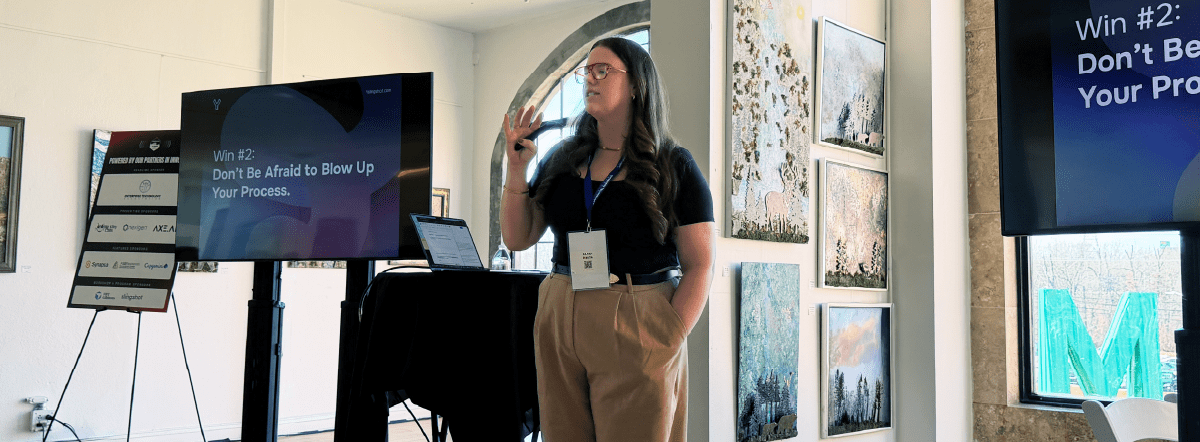
Somewhere between internal study sessions, community conversations, and invitations to share what we were learning, our roles expanded. We went from building quietly to being asked, more and more often, to share what we were seeing and how we were thinking about it in public.
This blog reflects on how that happened and what changed as learning turned into leadership.
Summary
Slingshot didn’t set out to become conference speakers. They set out to understand AI deeply enough to build with it responsibly. But when you learn faster than most and apply what you’re learning to real products, people start asking you to share. This is the story of how quiet study became public leadership, how imposter syndrome evolved alongside expertise, and why the best credibility comes from contributing to community first. It’s a reflection on what happens when learning turns into something bigger than you planned.
It Started With Learning, Not a Speaking Strategy
There was no initial plan to speak publicly about AI.
The starting point was much more practical. To us at Slingshot, AI didn’t feel like a feature or a passing trend. It was a shift that would change how software is built, how teams operate, and how decisions are made.
So we studied. “For a while, it honestly felt like being back in grad school,” said Sarah Bhatia, Director of AI Product Innovation at Slingshot. “I would wake up early and study AI, work my day job, and then study again at night. That pace was not sustainable long term, but it’s how we ramped up.”
This learning was primarily self-directed. It came from curiosity and a sense of responsibility. If this technology was going to reshape our work, we needed to understand it deeply enough to apply it thoughtfully.
Doug Compton, Principal AI Developer at Slingshot, felt that urgency from a technical perspective early on. “I’ve been really focused on AI because I knew it was clearly going to change our industry,” he said. “I wanted to understand where it was going, not just for myself, but so other developers would not be caught off guard.”
What started as informal knowledge sharing gradually built momentum. The conversations deepened, the questions sharpened, and before long, what we were working through internally began to feel relevant beyond our own walls.
Realizing Our Perspective Was Different
At first, the audience was just our team. The shift toward external visibility happened quietly.
As we applied what we were learning to real product work, a pattern started to emerge. Our approach to AI felt more grounded than much of what we were seeing around us. It was less speculative and more tied to outcomes, constraints, and long-term impact.
“We realized we were approaching AI strategy differently,” Sarah said. “We were learning quickly, but we were also applying it. And once you see that gap, you can’t ignore it.”
That realization didn’t lead to a marketing push. It led to conversations. Phone calls turned into panel invitations. Internal sessions became external workshops. Community discussions became recurring engagements.
The shift was subtle, but it clarified an important point. What had started as internal learning was beginning to resonate beyond our own walls.
Visibility had arrived, whether we intended it or not.
Imposter Syndrome Does Not Disappear, It Evolves
Increased visibility does not remove doubt. In many ways, it intensifies it.
Public speaking itself was not the challenge. The harder part was standing in front of others and discussing a field that is still changing in real time.
“It’s strange to be considered an expert in something so new,” Sarah said. “That naturally brings imposter syndrome with it.”
Doug experienced that tension from both sides. “I can see clearly that we’re ahead of many companies,” he said. “But I also follow researchers and developers who are far beyond where I am. Both things can be true at the same time.”
Over time, external conversations provided context. “The more I speak outside of Slingshot,” Sarah said, “the more I realize how early most organizations are in their thinking. That doesn’t mean we have everything figured out. It means we’re asking different questions sooner.”
That perspective didn’t eliminate doubt, but it reframed it. The focus shifted from proving credibility to staying honest and grounded in real experience.
Speaking Changes How You Work
As speaking became a regular part of our work, it began to influence how we approached our roles.
For Sarah, the shift was deliberate. “My role is intentionally split,” she said. “I continue to build and run products, and I also talk about what we’re learning. If I stopped building, I would lose the authority to speak from experience.”
For Doug, the change was more instinctive. “When I learn something new, my first thought is how to share it,” he said. “Internally and externally. Teaching feels like part of the responsibility now.”
That process of articulating ideas had downstream effects: writing clarified thinking, repetition refined frameworks, and conversations revealed gaps that work alone would not expose.
None of this was planned. It emerged as a byproduct of explaining complex ideas in simple terms.
When the Impact Became Bigger Than Business
There are moments when a technology stops feeling like a competitive advantage and becomes a societal shift.
For Doug, that moment came when he saw autonomous AI agents manage the full software development lifecycle. “That’s when it became clear this would fundamentally change how we build software,” he said. “Not eventually. Soon.”
For Sarah, it came from a different setting entirely. At a national education conference, she spoke about AI and watched elementary school students present on it. They discussed bias, prompting, and responsible use with clarity and confidence.
“One student said you have to be a detective and a DJ,” she said. “A detective to look for bias and hallucinations, and a DJ to remix the output and make it your own. It was better than how most adults explain it.”
That moment reframed the work. “This is not just a business conversation,” Sarah said. “It’s changing how people think and learn.”
Community First, Credibility Follows
One of the clearest lessons from the past year is that credibility cannot be claimed; it’s earned through contribution.
The Louisville AI Exchange reflects that mindset. It was co-created by Slingshot to provide a space for open conversation, not promotion. A place where people could share ideas, learn from one another, and build understanding together.
“The Louisville AI Exchange works because it’s genuine,” Sarah said. “It’s not about selling. It’s about creating space for real exchange.”
Doug summarized it simply. “If you’re interested, try it,” he said. “Get on the open mic and say what you’re thinking. Get feedback.”
By focusing on learning and community, authority followed naturally.
Looking Ahead
We don’t consider ourselves conference people. We see ourselves as builders who share what they learn, and as learners who care enough to speak when it matters.
The speaking is not the goal. It’s a side effect of curiosity, responsibility, and community involvement.
What matters is staying grounded in the work, honest about what we know and don’t know, and open to where these conversations lead.
We didn’t plan to end up here. But we are paying close attention to what it unlocks next.
Want some AI Communtiy?

Written by: Savannah Cherry
Savannah is our one-woman marketing department. She posts, writes, and creates all things Slingshot. While she may not be making software for you, she does have a minor in Computer Information Systems. We’d call her the opposite of a procrastinator: she can’t rest until all her work is done. She loves playing her switch and meal-prepping.

Expert: Sarah Bhatia
Sarah Bhatia brings people together. In her decade plus of product and product-adjacent experience, her focus has been on cross-functional collaboration, asking lots of questions, and getting big results. She excels at strategy development, and getting the right brains in the room to solve big problems. Sarah would describe herself as a daredevil, because she’s not afraid to ask “dumb“ questions, get smart answers, and take (calculated) risks.

Expert: Doug Compton
Born and raised in Louisville, Doug’s interest in technology started at 11 when he began writing computer games. What began as a hobby turned into his career. With broad interests that range anywhere from snorkeling, science, WWII history and real estate, Doug uses his “down time“ to create new technologies for mobile and web applications.
Frequently Asked Questions About AI Leadership and Strategy
Organizations become AI leaders by moving beyond experimentation and applying AI directly to real product and operational challenges. Leadership comes from combining deep learning, hands-on implementation, and a clear point of view grounded in business outcomes. Companies that build while they learn develop credibility faster than those that only theorize.
Responsible AI adoption means understanding model limitations, addressing bias, evaluating risk, and aligning AI initiatives with long-term strategy. It requires cross-functional collaboration between product, engineering, and executive leadership. The goal is sustainable integration, not short-term experimentation driven by hype.
AI is evolving rapidly, and executive decisions must be grounded in real implementation experience. Leaders who stay close to the build process gain clearer insight into feasibility, cost, talent needs, and competitive advantage. Speaking and teaching about AI reinforces this clarity by forcing ideas to be tested publicly.
Engaging in AI communities accelerates learning, exposes blind spots, and builds organizational credibility. Open conversations with peers, developers, and executives create feedback loops that sharpen strategy. Contribution builds trust, and trust positions organizations as thoughtful leaders rather than vendors.
AI hype focuses on tools and predictions. Practical AI implementation focuses on outcomes, constraints, governance, and long-term impact. Companies that prioritize measurable value, responsible experimentation, and continuous learning are better positioned to turn AI from a buzzword into a competitive advantage.