



In the fast-evolving world of artificial intelligence, staying competitive doesn’t just mean staying informed; it means staying hands-on.
For CEOs, the temptation to delegate learning is understandable. Time is tight, competing priorities pile up, and technology often feels like someone else’s job. But here’s the truth: business leaders who fail to prioritize experiential learning risk falling behind, fast.
As Slingshot’s Director of AI Product Innovation, Sarah Bhatia put it: “The risk of inertia is too great to gamble with the inconvenience of carving out time to learn.”
The companies that win in 2026 and beyond won’t be the ones who read the most. They’ll be the ones who built the muscle of hands-on learning early. Let’s break down why business leaders must make space for this, and what that looks like in practice.
Summary
Staying competitive in 2026 means more than keeping up with AI trends. It means engaging with them directly. CEOs who make time for hands-on learning send a clear signal: innovation starts at the top. This blog explores why curiosity drives better outcomes than passive awareness, how structured experimentation builds real confidence, and why applied learning is now a strategic imperative. You’ll learn how small moments of tinkering can lead to big shifts in thinking and results.
Curiosity Is a Competitive Edge
Both developers and business leaders face the same paradox: they’re too busy to learn the tools that will eventually save them time. As Doug Compton, Principal AI Developer at Slingshot, summed up: “People are too busy to learn the thing that saves them time.”
Doug’s not wrong. His own experience with hands-on AI learning didn’t start with a training module. It began with curiosity: “With hands-on learning, it’s really about curiosity and seeing how I can improve something. If I’m looking into a concept in AI that I’m not sure about, it’s better to see how it works in the AI context. ” Doug explained.
Sarah’s approach is similar; when she starts learning a concept, she finds something tangible to apply it to. “I like to engage with the tool by truly building something or solving a tangible problem. That helps me learn,” she said.

It’s not about playing with tech for the sake of novelty. It’s about building understanding through experience because that’s how real insights take root.
Reading About AI Isn’t the Same as Using It
AI is not a passive technology; you don’t just install it and walk away. Success with AI is all about nuance, especially when it comes to prompt engineering, security boundaries, and workflow integration. These are not things you can master from a white paper.
“There’s a broad spectrum of what you can do with these tools,” Sarah said. “Until you actually experience that light bulb moment of creating something, it doesn’t resonate in the same way.”
Doug added that the process of getting AI to do what you want is fundamentally experimental. “You have to try different things and see what works and what doesn’t,” he said. “That just requires experimenting.”
This kind of learning doesn’t scale through memos or meetings. It requires business leaders to foster a culture in which people are encouraged and given time to tinker.
Without Application, AI Initiatives Fail
Many AI pilots fail not because the technology isn’t ready, but because companies lead with tools instead of problems.
“That’s where we see a lot of AI initiatives fail,” Sarah said. “CEOs hear about a tool and say ‘Okay, here it is, go!’ without putting thought into use cases or problems they’re trying to solve.”
The answer is strategic but straightforward: start with a real problem and apply the tools to that. “It’s a much more effective approach to start with hands-on use case application, then grow and iterate from there,” Sarah advised.
This mindset shift from theoretical knowledge to applied experimentation is where CEOs must lead by example. If leadership doesn’t prioritize that mode of learning, the organization won’t either.
Hands-On Moments Spark Transformation
Learning AI isn’t just about gaining skills. It’s about confidence: realizing you can actually use these tools to create something new or improve the way you work.
Doug described one of his own light bulb moments during the Civic Pulse hackathon. “That was the first time I used AI to solve a business need,” he recalled. “I uploaded a document, asked it the kind of questions a client would ask, and got good results back. That was a big moment.”
Sarah has seen those breakthroughs in others. “There’s something magical that happens when someone starts with an idea or challenge and uses these tools to create a real solution. You see the excitement on their face when they realize what’s possible,” she said.
These aren’t minor moments. They shift mindsets. And once that happens, innovation follows.
Structured Play Leads to Practical Results
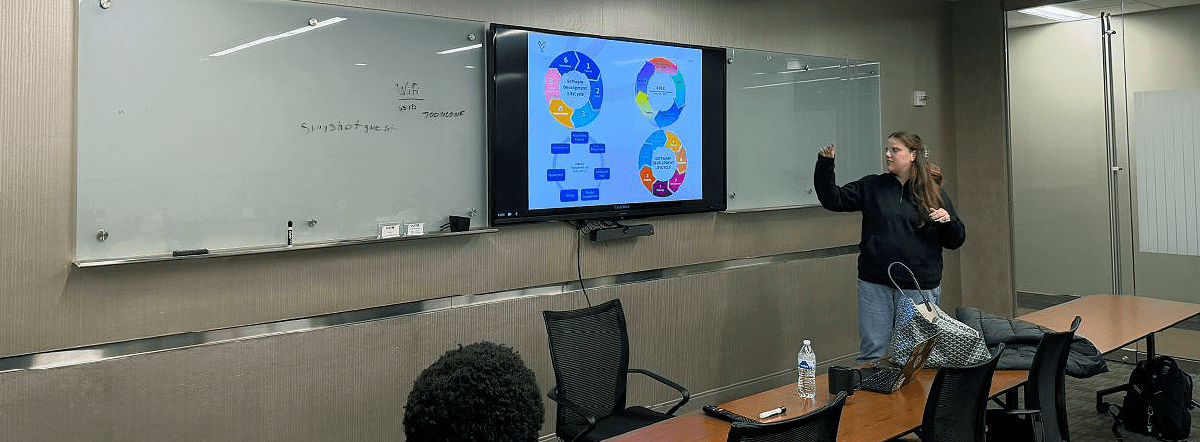
Slingshot has embraced this idea not just through client work, but in how the team trains itself. One of their more effective formats? Play time. Sometimes it’s a bootcamp. Sometimes a hackathon. Sometimes it’s just an afternoon set aside to try something new.
“Nobody likes being unbillable,” Sarah acknowledged. “But in the age of tools that are constantly shifting, it’s just as important to spend time exploring as it is doing client work. It’s our responsibility to be the experts, and we can’t do that without hands-on time.”
Doug agreed, noting that Slingshot has used internal sessions to tackle both learning and long-standing internal needs.
“We’ve had this backlog of internal things: DevOps automation, streamlining our process. These play sessions let us kill two birds with one stone. We solve real needs and learn new tools at the same time,” he said.
This tinkering isn’t wasted time. It’s ROI-rich experimentation that leads to better thinking, better tools, and ultimately, better outcomes.
The Bootcamp Blueprint: Think First, Then Build
The team’s bootcamp model is where the philosophy of experiential learning really comes to life. Each session starts with shared context, then quickly moves into applied creation.
“We start with aligning everyone on the information, then give them a structured playground to apply it,” Sarah said. “It’s less about learning a specific skill and more about learning a framework for thinking, how to think about AI as a collaborator.”
![“[At the Bootcamp], we start with aligning everyone on the information, then give them a structured playground to apply it. It’s less about learning a specific skill and more about learning a framework for thinking, how to think about AI as a collaborator.](https://b2168432.assetcdn.net/2.0/2168432/wp-content/uploads/2026/01/Why-CEOs-Must-Champion-Experiential-Learning-to-Stay-Ahead-1.png?lossy=2&strip=1&webp=1)
Participants choose from a mix of personal and work-related challenges, and by the end of the day, many go from chatbot to prototype.
Doug, who’s leading the developer-focused bootcamp, hopes to spark that same sense of possibility. “We’ll focus on agentic tools, showing them how AI can be used in different ways, from chatbots to document processing. It should open their eyes to what’s possible,” he said.
It’s not just about learning to use AI. It’s about learning to imagine what’s next and having the space to try.
Final Thought: CEOs Set the Tone for Learning
So what should CEOs take away from all this? You don’t need to be an AI expert. But you do need to be a learning advocate. Creating space for hands-on experimentation isn’t optional anymore. It is the only way to stay ahead.
“AI is here. Even if we stopped progress tomorrow, we can’t unring the bell,” Sarah said. “The longer you take to get up to speed, the harder it’s going to be to catch up.”
As Doug puts it, it’s a sharp truth that applies to nearly every team: “People are too busy to learn the thing that saves them time. But if you take the time to learn it, you’ll save more time than you spent.”
So what’s next? This New Year, make 2026 the year you give your teams, and yourself, the time to tinker, build, and learn by doing. Because strategy without experimentation is just theory. And theory won’t help you lead the future.

Written by: Savannah Cherry
Savannah is our one-woman marketing department. She posts, writes, and creates all things Slingshot. While she may not be making software for you, she does have a minor in Computer Information Systems. We’d call her the opposite of a procrastinator: she can’t rest until all her work is done. She loves playing her switch and meal-prepping.

Expert: Sarah Bhatia
Sarah Bhatia brings people together. In her decade plus of product and product-adjacent experience, her focus has been on cross-functional collaboration, asking lots of questions, and getting big results. She excels at strategy development, and getting the right brains in the room to solve big problems. Sarah would describe herself as a daredevil, because she’s not afraid to ask “dumb“ questions, get smart answers, and take (calculated) risks.

Expert: Doug Compton
Born and raised in Louisville, Doug’s interest in technology started at 11 when he began writing computer games. What began as a hobby turned into his career. With broad interests that range anywhere from snorkeling, science, WWII history and real estate, Doug uses his “down time“ to create new technologies for mobile and web applications.
Frequently Asked Questions
Hands-on AI learning helps CEOs understand the strategic potential and limitations of the technology. It enables better decision-making, faster adoption, and sends a clear signal to teams that innovation starts at the top.
Experiential learning involves directly interacting with tools and solving real problems, rather than just reading about them. For AI, this method builds deeper understanding and sparks innovation that theory alone cannot provide.
While technical teams play a critical role, CEOs need firsthand exposure to AI to set vision, evaluate use cases, and shape a culture of experimentation. Delegation without participation often leads to misalignment and missed opportunities.
Examples include internal AI hackathons, structured bootcamps, and play sessions focused on solving real business challenges. These formats create space for rapid learning and breakthrough ideas.
Experiential learning helps teams move from theoretical knowledge to real-world application. It leads to faster iteration, better problem-solving, and AI solutions that are aligned with actual business needs.